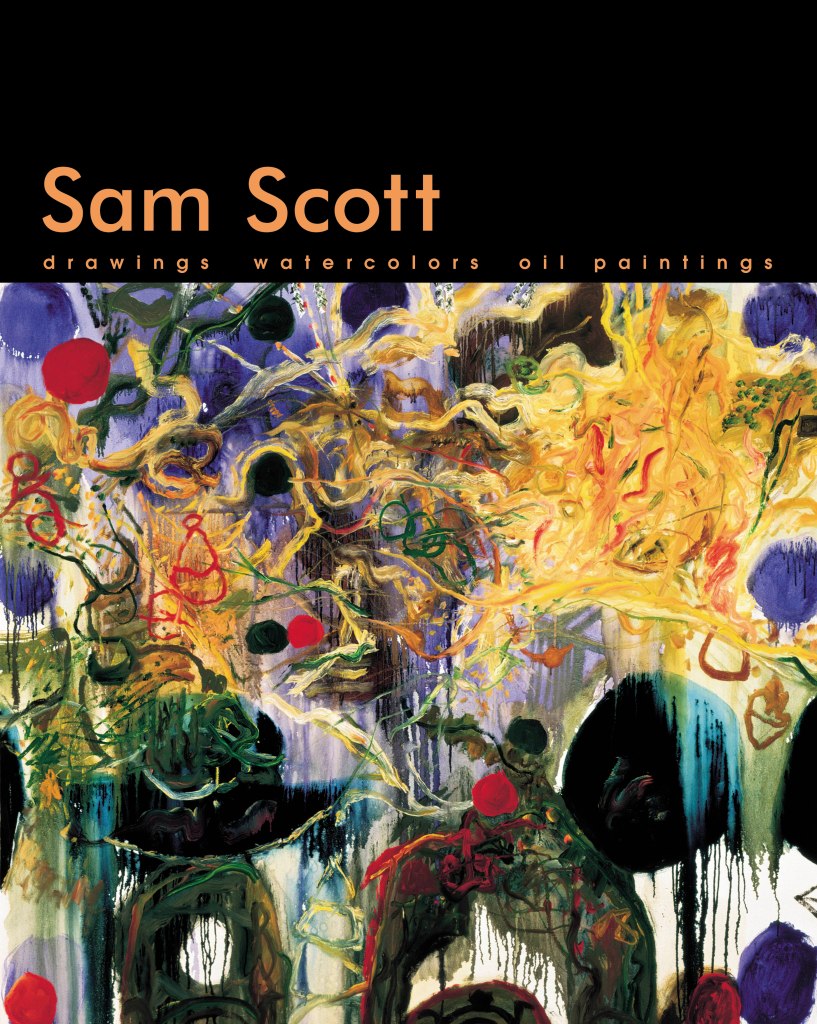
“To view from where painter Sam Scott stands is to see the spiritual in all things. In every touch of his brush on the canvas and, as importantly, where the pigment is omitted, Scott has serious intent. Each day as an artist is felt and considered; every new work containing the attention to each moment lived there.
Sam Scott is and always has been a painter in pursuit of Beauty. This is an uncomfortable phrase to the cynical, but Scott’s beauty resides only at great depths. It is hard-won and tentative. It emerges for this artist from the shadows as well as by the light of his noon Santa Fe sky. When he leaves the comfort of home, working in ways that are new to him, Scott travels well and freely. He generously reveals to us with his mark how it went and who he met along the way.
William Peterson’s Artspace magazine, published in Albuquerque and later in Los Angeles, was the authentic critical voice for contemporary art in New Mexico and the Southwest in the 1970’s through the early 1990’s. An editor, curator and publisher, Peterson is considered to be among the finest critical minds in contemporary American art.
Jim Edwards has been a curator of art since the early 1970’s and has curated nationally recognized exhibitions for the San Antonio Museum of Art and he co-curated the exhibition Pop Art: US/UK Connections 1956-1966 for The Menil Collection in Houston. He also curated the retrospective exhibitions, Doris Cross: Reworks and Sam Scott: An American Voice for the Fine Arts Museum, the Museums of New Mexico. Jim Edwards lives in Salt Lake City, Utah where he is Curator of Exhibitions at the Salt Lake Art Center.
Size: 11.5 x 9.5 in.
Pages: 112
Plates: 90 color plates
Softcover
ISBN: 978-0-9741023-7-7
Also by Sam Scott, see: Encounters with Beauty
 Fresco Books